Autism: Why Do They Behave Differently?
Autistic individuals often appear to have very different ways of thinking and behaving. For example, they might laugh during serious situations or seem to struggle to blend into social environments.
Why does this happen?
The following insights are based on research with Gavin Min, an autistic person who, like Dr. Temple Grandin (TED; https://www.ted.com/talks/temple_grandin_the_world_needs_all_kinds_of_minds), thinks in pictures. Gavin is currently studying biology at Simon Fraser University in Burnaby, BC, Canada.
According to Gavin, sensory inputs such as sights and sounds trigger ‘random images’ in his brain. These images can take many forms — cartoon-like movies, virtual-reality-like visuals, or still images — and they appear spontaneously, outside of his conscious control.
Over time, Gavin has learned to manage these images and even use them productively in his studies. For instance, when learning chemistry, he visualizes molecules and simulates chemical reactions in his brain, which helps him understand complex concepts. However, random images still appear unexpectedly, affecting his emotions and behaviours.
In neurotypical individuals, sensory inputs are often translated directly into emotions— for example, seeing an accident might evoke feelings of worry or sympathy. Logical thinking can also occur, but typically requires conscious effort or training.
For autistic individuals, however, the process can include an extra step: the sensory input first triggers images before emotions are responded. The emotions from these images could be very different from those of others, as shown in the figure below.
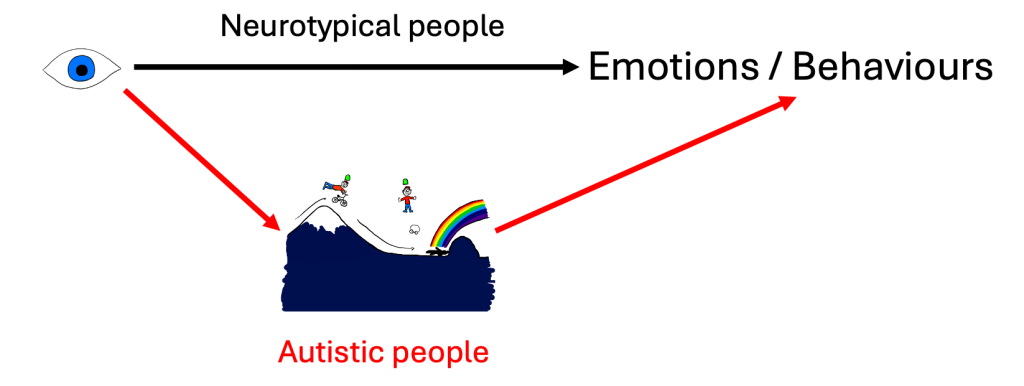
Gavin illustrates this with a personal story. Once, when he saw a cyclist fall into a ditch and was seriously injured, he unexpectedly started laughing. His laughter was not caused by the accident itself, but by a humorous image that appeared in his mind — a cartoon-like scene where a person fell, hit a rock, and instead of blood, a rainbow appeared. This sudden mental image triggered laughter rather than empathy.
Similar situations occur frequently for him. Sometimes, animals in his mental images make sounds that force him to mimic them. At other times, his stuffed animals appear in his brain and interact with each other like real friends. These randomly generated images can strongly affect both his emotions and his behaviour.
Gavin explains that these images become manageable once they are conceptualized— a key term in the ‘PonderEd Methods (newly developed educational methods for brain development)’. For example, he used to be frightened of a dark room because an image of a deep-sea anglerfish attacking him would appear. But after exploring real anglerfish — such as their size, habitat, and behaviours — that image no longer scared him. In other words, by understanding the concept behind the image, he could control sudden emotions.
Research conducted by PonderEd suggests that this conceptualization process transforms random images into controlled ones. Once controlled, these images can be used for visualization and simulation — just as Dr. Temple Grandin has described in her TED talk.
Before the development of PonderEd Methods, there were no systematic educational approaches for neurodivergent people to develop thinking processes through conceptualization and concept connection. With PonderEd’s newly developed teaching and learning strategies, both neurodivergent and neurotypical people can now systematically develop their brains.
PonderEd represents a new direction in education toward the development of the human brain itself, regardless of their preferences in thinking, such as thinking in pictures.